Seeing ants marching across your kitchen counter is one of those tiny household annoyances that somehow feels huge.
You wipe the counter. They come back.
You move the sugar. They find the sink.
You clean one trail, and suddenly another line appears near the pantry, bathroom, window, or baseboard.
If you’re looking for an ant killer DIY indoor solution, the good news is that you have several options. Some homemade ant killers work by killing ants quickly on contact.
Others work more slowly as bait, which can be more helpful because ants carry the bait back to the colony.
The important thing is knowing the difference.
A spray may kill the ants you see, but it may not stop the colony. A bait may take longer, but it can work better for the bigger problem.
Extension and pest-management sources commonly recommend sealing entry points, cleaning ant trails, and placing bait near ant trails so ants carry it back instead of only killing the visible foragers.
Below are the best DIY indoor ant killer ideas, including sugar baits, grease ant baits, vinegar sprays, dish soap sprays, prevention tips, and safety notes for homes with kids and pets.
Why Ants Come Inside
Ants usually come indoors because they are looking for food, water, or shelter. Kitchens are the obvious place, but ants can also show up in bathrooms, laundry rooms, bedrooms, windowsills, pet feeding areas, and around sinks.
Common things that attract ants indoors include:
- Sugar spills
- Crumbs
- Grease
- Honey or syrup
- Pet food
- Open trash
- Dirty dishes
- Damp sinks
- Leaky pipes
- Sticky counters
- Fruit bowls
- Pantry food that is not sealed
Ants also leave scent trails so other ants can follow the path. That is why wiping the trail matters.
UC Agriculture and Natural Resources recommends wiping up ants and their chemical trails with an all-purpose cleaner and sealing small gaps, cracks, and holes with caulk to make entry harder.
Before You Make DIY Ant Killer, Find the Ant Trail
Before mixing anything, watch the ants for a few minutes. I know, not glamorous. But it helps.
Look for where they are:
- Coming in
- Going out
- Gathering
- Feeding
- Disappearing into cracks
- Moving along baseboards
- Entering near windows, doors, or pipes
This tells you where to place bait or where to spray. Randomly spraying the whole kitchen usually wastes product and may scatter the ants.
If you see a steady trail, that is a good place for bait.
This recipe works and it’s just one of 60+ natural pest recipes in the Pest-Free Home Playbook. Every indoor ant killer method in one place, plus 24 other pests.
DIY Ant Killer Spray for Indoor Ants
This is the fastest DIY option for ants you can see crawling on counters, floors, sinks, or windowsills.
You’ll need:
- 1 cup water
- 1 tablespoon dish soap
- Spray bottle
- Paper towels or cloth
How to make it:
Pour water into a spray bottle, then add dish soap. Gently shake the bottle.
Spray directly on visible ants. The soapy water helps break down the ants’ outer coating and can kill them on contact. After spraying, wipe the area clean.
This is helpful for a quick cleanup, but it does not kill the colony. Use it when you need to remove ants fast, then follow with bait and prevention.
Helpful option: Check price on Amazon
Vinegar Spray for Ant Trails
Vinegar is not the strongest ant killer, but it can help disrupt ant scent trails. That makes it useful after you clean up the visible ants.
You’ll need:
- 1 cup white vinegar
- 1 cup water
- Spray bottle
- Cloth or paper towel
How to use it:
Mix equal parts vinegar and water in a spray bottle. Spray along ant trails, counters, windowsills, baseboards, and entry points. Wipe clean after a few minutes.
This does not usually eliminate the nest, but it helps remove the chemical trail ants use to guide each other.
Avoid using vinegar on natural stone surfaces like marble, granite, limestone, or travertine because acid can damage stone.
For this step: View options on Amazon
DIY Borax Sugar Ant Bait
Borax sugar bait is one of the most popular homemade ant killer recipes because it works as bait. Ants are attracted to the sugar, then carry the borax mixture back to the colony.
But safety matters here.
Borax and boric acid products can cause exposure if they get on skin, in eyes, are inhaled, or are accidentally eaten, and exposures can happen if products are accessible to children or pets.
The National Pesticide Information Center says exposure can be limited by following label instructions carefully.
So if you have children or pets, place bait only where they cannot reach it.
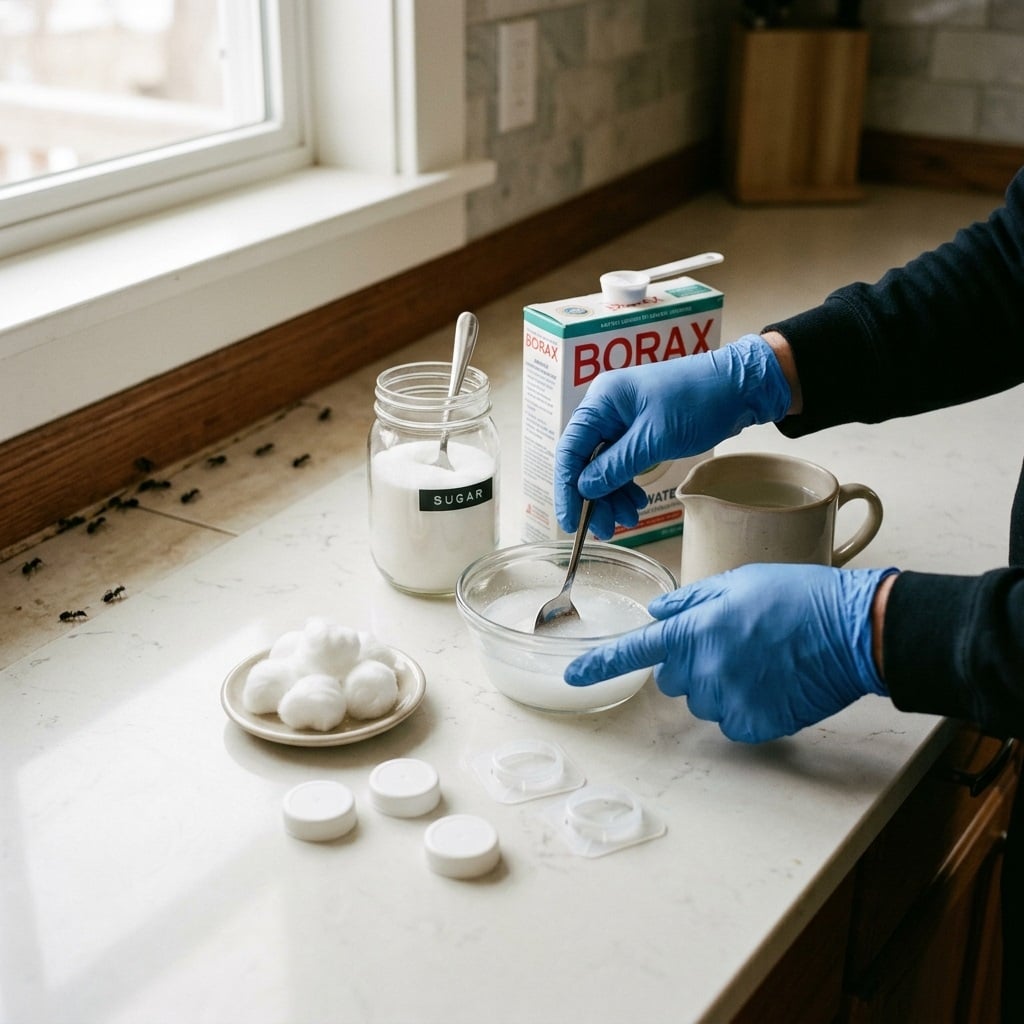
You’ll need:
- ½ cup sugar
- 1½ tablespoons borax
- 1½ cups warm water
- Cotton balls
- Shallow lids or small bait containers
- Gloves
How to make it:
Mix the sugar and borax in warm water until dissolved. Soak cotton balls in the mixture, then place them in shallow lids or small bait stations near ant trails.
Do not place the bait directly on counters where food is prepared. Put it behind appliances, under sinks, near baseboards, or close to entry points where ants travel — but away from kids and pets.
How long it takes:
Borax bait is not instant. That is the point. You want ants to carry it back. Give it several days and avoid killing every ant on the trail while they are feeding on the bait.
Helpful option: Get it on Amazon
DIY Honey Borax Ant Bait
Some ants prefer sweet liquid foods. If you see ants going after juice, honey, syrup, sugar, or fruit, a honey bait may work well.
You’ll need:
- 2 tablespoons honey
- ¼ teaspoon borax
- Small lid or bottle cap
- Toothpick or spoon
How to make it:
Mix the honey and borax very well. Place a tiny amount in a bottle cap or shallow lid near the ant trail. Keep it far away from children and pets.
The mixture should be attractive enough that ants feed on it and carry it back. If ants ignore it, they may be looking for grease or protein instead of sugar.
Stop making one recipe at a time. Get all 60+ in one place.
The Pest-Free Home Playbook has every DIY indoor pest recipe, ants, roaches, spiders, flies + 21 more. Exact ingredients, exact amounts. Get the complete guide →
DIY Peanut Butter Ant Bait for Grease Ants
Not all ants want sugar. Some indoor ants are more attracted to protein or grease. If they are showing up around meat, pet food, oily crumbs, peanut butter, or greasy pans, try a grease-based bait.
Utah State University’s IPM ant guide notes that baiting can take several days or longer and that you may need to change baits if ants are not feeding on the one you placed. (Utah State University Extension)
You’ll need:
- 1 tablespoon peanut butter
- ¼ teaspoon borax
- Small lid
- Toothpick
How to make it:
Mix peanut butter and borax thoroughly. Place a tiny amount in a small lid near the ant trail. Use very small amounts so it does not become messy or attractive to pets.
This can work better for grease-loving ants than sugar water.
DIY Baking Soda and Powdered Sugar Ant Killer
This is another common homemade ant killer recipe. The idea is that powdered sugar attracts ants, while baking soda is the active ingredient.
You’ll need:
- 1 tablespoon baking soda
- 1 tablespoon powdered sugar
- Small lid or shallow container
How to use it:
Mix equal parts baking soda and powdered sugar. Place small amounts near ant trails, under sinks, behind appliances, or near entry points.
This is less reliable than borax bait, but some people like it because the ingredients are common household items. Keep it away from pets and children anyway, because you do not want them eating random powders from the floor.
Easy add-on: Check price on Amazon
Cornmeal for Ants: Does It Work?
Cornmeal by itself is not a dependable ant killer.
You may see claims that ants eat cornmeal, it expands inside them, and they die. That is a popular myth.
Recent pest expert guidance has noted that cornmeal alone does not reliably kill ants and may even attract them if it is used without a true active ingredient.
If you want to use cornmeal, it is better as a bait carrier mixed with an actual ant-killing ingredient — not as the only method.
Diatomaceous Earth for Indoor Ants
Food-grade diatomaceous earth is often used around baseboards, cracks, under appliances, and entry points. It works physically by damaging the outer layer of insects, which causes them to dry out.
You’ll need:
- Food-grade diatomaceous earth
- Small duster or spoon
- Mask, optional but helpful
- Gloves
How to use it:
Apply a very thin layer near ant entry points, under appliances, around baseboards, or near cracks where ants travel. Do not pile it up. A light dusting works better than clumps.
Avoid breathing in the dust, and keep it away from children and pets. Do not use pool-grade diatomaceous earth indoors.
Helpful option: View on Amazon
Cinnamon, Peppermint, and Essential Oils for Ants
Strong scents like cinnamon, peppermint, clove, lemon, and tea tree may help repel ants temporarily or disrupt scent trails. But they usually do not kill the colony.
Simple peppermint ant spray
You’ll need:
- 1 cup water
- 10 drops peppermint essential oil
- Spray bottle
Shake and spray lightly around baseboards, window frames, doorways, and entry points.
Do not spray essential oils where pets can lick them, and be especially careful around cats. Essential oils can be risky for pets.
This is better as a repellent support method, not your main ant killer.
Best Places to Put Indoor Ant Bait
Placement makes a huge difference.
Put bait near:
- Ant trails
- Under the sink
- Behind appliances
- Along baseboards
- Near window frames
- Near door thresholds
- Around plumbing openings
- Behind trash cans
- Near pantry corners
Do not place bait in the middle of a counter or where kids and pets can reach it.
Small amounts placed strategically near trails often work better than large amounts randomly spread around the house. Pest-management guidance for indoor colonies recommends identifying trails and placing baits directly into cracks and crevices near nest sites. (FSM.How (Facility & Services Management))
How to Make DIY Indoor Ant Killer Work Better
1. Do not clean away the bait trail too soon
If ants are actively feeding on bait, let them. You want them to carry it back.
2. Remove other food sources
If crumbs, honey, pet food, or dirty dishes are available, ants may ignore your bait.
3. Try sweet and greasy bait
If sugar bait fails, try peanut butter bait. If peanut butter bait fails, try sugar bait.
4. Seal entry points
Caulk small cracks, gaps, and holes. EPA pest prevention guidance recommends caulking small holes to help seal out insects. (US EPA)
Helpful option: Check price on Amazon
5. Fix moisture problems
Ants often come inside for water. Repair leaks, dry under-sink areas, and wipe moisture around sinks.
This DIY works. Want every other natural pest recipe in one place too? Pest-Free Home Playbook →. 25 pests, 60+ recipes, done.
How to Prevent Ants From Coming Back Indoors
Once the ants are gone, prevention is the real secret.
Try this routine:
- Wipe counters every night
- Store sugar, cereal, flour, and snacks in sealed containers
- Take out trash often
- Clean under appliances
- Do not leave pet food out overnight
- Fix leaky faucets
- Seal cracks around doors and windows
- Rinse sticky bottles before storing them
- Sweep crumbs daily
- Keep fruit bowls clean
Airtight pantry containers are especially helpful because ants can get into thin cardboard and loosely closed bags.
For your pantry: Get it on Amazon
Safety Tips for DIY Indoor Ant Killers
Homemade does not automatically mean harmless. Borax, boric acid, essential oils, and powders should be handled carefully.
Keep these safety tips in mind:
- Keep borax bait away from kids and pets.
- Do not place bait on food-prep surfaces.
- Label homemade mixtures.
- Wash hands after handling borax or powders.
- Avoid breathing in powder products.
- Do not use essential oils around pets without checking safety first.
- Store ingredients securely.
- Clean spills right away.
- Use bait stations when possible.
Poison Control recommends storing boric acid out of reach of children and pets, avoiding ingestion or inhalation, washing hands after handling it, and using ventilation if working in a confined space. (Poison Control)
When to Call a Pest Control Professional
DIY indoor ant killer works well for many small ant problems, but sometimes the infestation is bigger than it looks.
Call a professional if:
- Ants keep returning after several weeks
- You see carpenter ants
- You find ants in walls
- You see sawdust-like debris
- You have ants near electrical outlets
- Ants are spreading room to room
- You have pets or children and cannot safely place bait
- DIY bait is not working
- You suspect a nest inside the house
Carpenter ants are especially important because they can nest in damp or damaged wood. If you see large black ants indoors regularly, especially near wet wood, get help.
FAQs About DIY Indoor Ant Killer
What is the best homemade ant killer for indoors?
The best homemade indoor ant killer is usually a slow-acting bait, such as sugar water mixed with a small amount of borax. Ants carry the bait back to the colony, which can be more effective than only spraying the ants you see.
What kills ants instantly indoors?
Soapy water can kill visible ants quickly when sprayed directly on them. Mix water with dish soap in a spray bottle, spray the ants, then wipe the area clean.
Does vinegar kill ants indoors?
Vinegar can kill some ants on contact, but it is more useful for disrupting scent trails. Mix equal parts white vinegar and water, spray the trail, and wipe it clean.
What is the best DIY ant bait for sugar ants?
A sugar-based bait made with sugar, warm water, and a small amount of borax can work well for ants attracted to sweet foods. Keep it away from children and pets.
What is the best DIY ant bait for grease ants?
A peanut butter and borax bait may work better for ants attracted to grease, protein, or pet food.
Is borax safe to use for ants indoors?
Borax can be used carefully in ant bait, but it should be kept away from children and pets. Do not place it on food-prep surfaces, and wash your hands after handling it.
Why are ants ignoring my bait?
They may not be interested in that food type. Try switching from sugar bait to peanut butter bait, or from grease bait to sugar bait. Also remove other food sources so the bait is more attractive.
How long does DIY ant bait take to work?
DIY ant bait may take several days or longer. It is not instant because ants need time to carry it back to the colony.
How do I stop ants from coming back?
Clean food spills, remove crumbs, seal pantry food, fix leaks, wipe scent trails, and caulk entry points around windows, doors, pipes, and baseboards.
Final Thoughts
DIY indoor ant killer can work well when you use the right method for the problem.
If you only want to kill the ants you see, use soapy water spray. If you want to target the colony, use a slow-acting bait like sugar borax bait or peanut butter borax bait. Then clean trails, seal entry points, remove food sources, and keep the kitchen dry.
The real trick is not just killing ants once. It is making your home harder for them to enter, less attractive to search, and easier for you to maintain.