Every time you wear something white, it absorbs oils from your skin, traces of deodorant, body sweat, dust from the air, and even detergent residue left behind in the fibers.
These build up gradually, dulling that original brightness. If your area has hard water, meaning water with minerals like calcium and magnesium, the problem gets worse.
Those minerals cling to the fabric, giving your whites a stiff, greyish tint that won’t budge, no matter how many times you wash them.
And while bleach might seem like the hero here, it’s not always the right answer. Bleach can weaken fibers, cause yellowing, or leave harsh chemical smells.
Some fabrics, especially synthetic blends or delicate cottons, don’t take bleach kindly. That’s where the quiet, underestimated pantry staple steps in, baking soda.
You’ve probably used it to deodorize a fridge or make cookies rise, but in laundry, it’s a mild miracle. Baking soda (sodium bicarbonate) is a gentle alkali, which means it helps lift acidic residue, sweat, oils, and detergent scum, from fabric.
It slightly raises the water’s pH, making detergent work better and giving fibers space to breathe again. It also neutralizes odors and softens water a little, which is why clothes come out feeling softer and looking brighter.

Most people underestimate how much detergent buildup is actually hiding in their favorite white clothes. Over time, those residues trap dirt instead of releasing it.
Baking soda works like a gentle detox for your laundry, balancing everything out. It’s a quiet fix, but one that actually works, especially when you make it part of your regular laundry routine.
So yes, you could keep buying new white shirts every few months. Or you could grab a simple box of baking soda and learn a few tricks that make your current ones look new again.
What You’ll Need (Ingredients and Tools)
Before you start whitening, you don’t need an entire shelf of fancy detergents. The beauty of this method is that it’s simple, budget-friendly, and effective. Most of what you need is already sitting in your laundry room or pantry.
Think of this as a mini toolkit, not the kind that overwhelms you, but the kind that quietly gets the job done every single wash.
Your Laundry Essentials
- White clothes only. This sounds obvious, but don’t skip it. Always separate your whites from everything else, no “just this one light-grey towel” sneaking in. Color transfer is sneaky, and even one wash with tinted fabrics can undo your effort.
- Baking soda (sodium bicarbonate). The star of the show. It balances pH, lifts residues, and brightens fibers without damaging them. Regular kitchen baking soda works fine, but if you want a version designed for laundry, go for a heavy-duty brand like Arm & Hammer Baking Soda Laundry Booster & Odor Eliminator. You can grab it here → Arm & Hammer Baking Soda Laundry Booster
- Your usual detergent. You’ll use it alongside baking soda for that extra cleaning punch. Choose a mild, non-chlorine detergent if you’re dealing with delicate cottons or mixed fabrics.
- Warm water. Most white clothes respond best to warm, not hot, water. It helps dissolve oil and grime better than cold, yet it’s gentle enough for fibers.
- Soft brush or old toothbrush. Handy for pretreating collars, cuffs, or sweat marks before washing.
- A soaking tub or bucket. Perfect for pre-soak whitening treatments if you’re doing this by hand or tackling deep stains.
- Optional: white vinegar. Some people like adding it in a separate rinse cycle for a final deodorizing rinse (never mix vinegar and baking soda together, they cancel each other out).
Optional Helpers for Stubborn Stains
If you have yellowing around collars or armpits, or even those mysterious old grey tones that just won’t budge, keep these extras nearby:
- Hydrogen peroxide (3%) — a mild bleach alternative that works wonders with baking soda paste.
- A clean microfiber cloth — to dab or apply your paste mixture neatly.
- Measuring cup or scoop — for consistency if you want to get exact (half a cup is roughly 120 ml).
Quick Tip for Scent Lovers
If you love that fresh laundry smell, you can toss in a few drops of essential oils—like lemon, eucalyptus, or lavender, on a wool dryer ball or cotton cloth before drying. They add a soft scent without synthetic residue.
You really don’t need much more than this. The combination of detergent, baking soda, and warm water already does 90% of the whitening work. It’s about balance, too many additives often make things worse by coating the fabric.
Once your essentials are lined up, the next step is the fun part: actually washing and seeing your whites come back to life. Let’s get into the method that works, the baking soda way.
Step-by-Step – How to Make White Clothes Whiter With Baking Soda
You’ve got your baking soda, your detergent, and that pile of tired-looking white clothes waiting for redemption.
Now comes the good part, actually making them bright again. Think of this as a gentle reset for your wardrobe. You’re not just washing clothes; you’re reviving them.
Step 1: Sort and Inspect
Start by separating your whites from everything else, even light colors like cream or pastel grey. Any trace of dye can ruin the results.
Take a few minutes to look over each piece. Spot any yellow underarms, dull collars, or grey socks? That’s where you’ll focus later with a baking soda paste or soak.
If your washing machine has detergent buildup or residue (you’ll know by that musty smell), run a quick cleaning cycle with ½ cup of baking soda and hot water before you start.
A clean machine means cleaner clothes.
(Amazon pick: Arm & Hammer Super Washing Soda Laundry Booster)
Step 2: Load the Washer and Add Your Detergent
Place your whites in the drum, making sure not to overload. Clothes need room to move so water can flow through the fibers. Add your regular amount of detergent directly into the machine as usual.
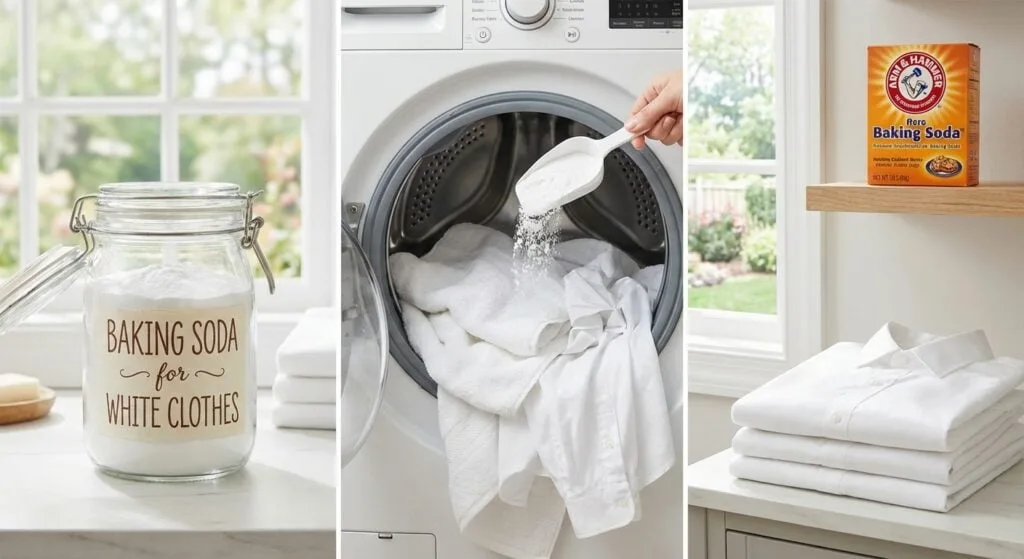
Now sprinkle ½ cup of baking soda straight into the drum, not the detergent compartment.
That’s where most people go wrong. When it’s in the drum, it dissolves evenly and works directly on the clothes.
If you’re handwashing, fill a large basin with warm water, add your detergent, and stir in ½ cup of baking soda until it’s fully dissolved.
Then let your whites soak for at least 30 minutes before scrubbing lightly or rinsing.
Step 3: Choose the Right Cycle
For most whites, a warm-water cycle works best, it helps lift oils and residues without damaging the fabric. If your whites are heavily soiled, use your washer’s “whites” or “heavy-duty” setting.
Delicate fabrics like lace or linen? Stick to cold water and a gentle cycle. Baking soda still works effectively in cooler temperatures; it just takes a little longer.
For extra brightening, you can add a rinse cycle with ½ cup white vinegar, but do it separately after the baking soda wash (never mix them together in the same cycle — they cancel each other out).
Step 4: Dry for Brightness
Once the cycle finishes, shake out your whites and hang them to dry in direct sunlight if possible.
The sun has a natural bleaching effect, nature’s free whitening trick. Just be sure not to leave delicate fabrics baking out there all day; a few hours is plenty.
If you prefer the dryer, toss in a wool dryer ball with a drop of lemon or lavender essential oil for a fresh scent.
Avoid over-drying, heat can make whites look dull or stiff.
(Amazon pick: Wool Dryer Balls for Laundry – 6 Pack)
Step 5: Repeat for Lasting Results
Don’t wait until your whites look yellow to do this. Add baking soda every two or three washes as part of your regular laundry routine.
It’ll help prevent buildup, neutralize odors, and keep the fibers open so your clothes reflect more light, that’s what gives them that “brand-new” glow.
You can even mix a small jar of baking soda and detergent powder in a 1:1 ratio and keep it ready as your personal “whitening booster.” Just scoop a bit into each wash, and you’re set.
Extra Whitening Trick (for Set-in Yellowing)
If your whites have serious yellow or grey tones, try this stronger combo:
You’ll need:
- ½ cup baking soda
- ½ cup hydrogen peroxide (3%)
- 1 tablespoon laundry detergent
- 2 liters of warm water
Mix everything in a large basin or tub. Soak your garments for 1–2 hours (or overnight for deep stains), then wash as normal. The hydrogen peroxide acts like a gentle oxygen bleach, while baking soda softens the water and loosens residue.
(Amazon pick: Hydrogen Peroxide Solution 3% for Cleaning & Laundry)
Baking soda might be simple, but it’s shockingly effective. The best part? It doesn’t just make whites look cleaner, it makes them feel cleaner too.
The fabric regains that crispness and lightness it had when it was new, without that strong bleach scent.
Pre-Treatment Hacks for Stubborn Stains
Let’s be honest, not all whites fade evenly. Some pieces have battle scars. A ring around the collar, yellowed armpits, coffee splashes on sleeves, or that mysterious grey tone that never seems to wash out.
These aren’t hopeless; they just need a little one-on-one attention before the main wash.
Baking soda isn’t just a booster here, it becomes your mini stain-removal lab. Its gritty texture and gentle alkalinity lift grease, neutralize odor, and break down the acid-based residues that regular detergent misses.
Here’s how to put it to work before you toss your clothes in the machine.
The Baking Soda Paste (Spot Treatment)
This method is simple, cheap, and works like magic on sweat stains, underarm yellowing, and mild discoloration on cottons or blends.
You’ll need:
- 2 tablespoons baking soda
- 2 tablespoons water (enough to make a paste)
- A small bowl
- A soft toothbrush or cloth
How to use:
Mix the baking soda and water until it forms a thick, spreadable paste. Apply it directly on the stain and gently scrub with your brush in small circles, don’t be too aggressive.
Let it sit for 30 minutes to an hour. For tougher spots, leave it overnight (cover it lightly with plastic wrap so it doesn’t dry too fast).
Then rinse and launder as usual.
This paste naturally brightens without bleaching and is safe for most cotton, polyester, or mixed-fabric whites.
(Amazon pick: Arm & Hammer Baking Soda 5 lb Bag)
The Soak-and-Soften Bath (For Heavily Soiled Whites)
Perfect for T-shirts, towels, or socks that have lost their sparkle.
You’ll need:
- 1 gallon (about 4 liters) of warm water
- ½ cup baking soda
- 1 tablespoon laundry detergent
Fill a tub or basin, add the detergent, sprinkle in baking soda, and stir until dissolved. Soak your whites for at least 1–2 hours (overnight for deep yellowing).
The warm water opens fibers while baking soda lifts residues and neutralizes smells.
You’ll notice the water turning slightly murky, that’s all the old residue coming off. It’s oddly satisfying.
Rinse thoroughly and run a regular cycle the next day.
The Brightening Boost (Baking Soda + Hydrogen Peroxide)
For whites that look like they’ve seen better days, especially shirts or pillowcases that have gone cream-yellow.
You’ll need:
- ½ cup baking soda
- ½ cup hydrogen peroxide (3%)
- 1 tablespoon dish soap or laundry detergent
Mix in a small bowl. Using a toothbrush or soft cloth, spread the mixture on the stained areas. Leave for 30 minutes, then wash as usual.
The hydrogen peroxide provides oxygen-based whitening while baking soda loosens buildup.
It’s safe, effective, and smells far less harsh than bleach. Just avoid using it on silk, wool, or anything marked “dry clean only.”
(Amazon pick: Hydrogen Peroxide Solution 3% – Cleaning Grade)
4. The Collar & Cuff Rescue
Those subtle grey bands around collars or sleeve edges often need their own treatment.
You’ll need:
- 1 teaspoon baking soda
- A few drops of water or detergent
- A soft toothbrush
Dampen the area slightly, dab the baking soda paste, and scrub gently along the seam. Leave for 15 minutes before washing.
The mild abrasion helps lift trapped oils where fabric folds collect grime.
If the stains are old, pair this with the hydrogen peroxide mix from Step 3 — it makes a noticeable difference.
Extra Tip: Make a Pre-Mix Jar
Keep a small jar in your laundry room labeled “White Rescue Paste.” Pre-mix baking soda and water until it forms a soft paste, then store sealed for up to a week.
Anytime you notice a spot, dab a little before it sets in. Quick action beats long soaking later.
Pre-treating isn’t extra work once you get used to it. It’s like giving your whites a little attention before their spa day.
A few minutes of effort can save you from tossing another “yellowed” T-shirt in frustration.
Dos and Don’ts – Fabrics, Machines, and Mixtures
Every laundry hack has limits. Baking soda may be gentle, but like any cleaning agent, using it wrong can cause more harm than good.
The trick isn’t just what you use, it’s how and where. Let’s go over the most common dos and don’ts to keep your whites looking spotless and your fabrics safe.
DO: Check Fabric Labels Before Anything Else
You’d be surprised how many “white” fabrics aren’t pure cotton. Blends like rayon, viscose, and polyester react differently to pH changes.
Baking soda is safe for most cottons and linens, but if your care tag says “dry clean only” or “hand wash cold”, skip the full-strength soak.
If you’re unsure, test a small patch first, maybe the inside seam or hem. It’s a tiny step that saves your favorite blouse.
DO: Measure — Don’t Guess
More isn’t better. Use around ½ cup of baking soda per load or ¼ cup for small loads. Too much powder can clump, leaving chalky streaks, especially in cold cycles.
Keep a small scoop or tablespoon near your washing machine just for this. Once you start measuring, you’ll notice more consistent results.
(Amazon pick: OXO Good Grips Mini Measuring Cup Set)
DO: Add Baking Soda to the Drum, Not the Dispenser
This one makes a real difference. Pouring baking soda into the detergent drawer can cause clogs or slow drainage over time.
Sprinkle it straight into the drum before adding clothes. That way it dissolves evenly and touches every fiber.
DO: Let Sunlight Do Its Part
After washing, hang your whites where natural light can reach them. Sunlight has a mild bleaching effect, and when combined with baking soda’s whitening power, you’ll notice your whites look almost “airy.”
If you live somewhere humid, choose a spot with good airflow to prevent musty smells.
(Amazon pick: Stainless Steel Drying Rack for Clothes)
❌ DON’T: Mix Baking Soda and Vinegar in the Same Cycle
It’s one of those internet myths that refuses to die. Baking soda is alkaline, vinegar is acidic, together they neutralize each other.
You’ll just end up with a fizzing reaction that looks satisfying but cleans nothing.
If you like using both, do them separately:
- Baking soda during the wash cycle
- Vinegar during the rinse cycle
That way, you actually get the benefit of each.
DON’T: Overload the Washing Machine
Cramming your whites into a single load might feel efficient, but it prevents water and detergent from moving freely.
The result? Dingy whites that never quite rinse clean.
As a rule of thumb, your drum should be no more than three-quarters full — enough space for everything to swish around properly.
DON’T: Use Baking Soda on Delicate Fabrics Like Wool or Silk
These natural fibers have a slightly acidic structure. When exposed to baking soda repeatedly, they can weaken or lose texture.
It’s the same reason you shouldn’t use alkaline soap on your hair, it strips the natural oils.
If your delicate whites need brightening, stick to mild detergent and cold water instead.
(Amazon pick: The Laundress Delicate Wash – Whites & Silk Safe)
DON’T: Expect Instant Results on Old Set-In Stains
If a shirt has been dull for years, baking soda alone might not bring it back to pure white in one go.
Think of this as maintenance, not a magic wand. With consistent use, maybe one or two washes a week, you’ll start to notice lasting brightness.
You can always combine it with hydrogen peroxide (see Section 4) for stronger whitening when needed.
DON’T: Store Baking Soda Near Moisture
If your laundry area is humid, keep your baking soda in an airtight jar. It absorbs moisture easily, which can make it clumpy and less effective.
Baking soda is one of those ingredients that quietly works behind the scenes.
Respect its simplicity, use it right, and it’ll never fail you. It’s not a trend, it’s a classic that’s been trusted for generations.
Keeping Whites White (Follow-Up Habits & Tips)
It’s one thing to bring your whites back to life, but the real win is keeping them that way.
Most people think the brightness fades because of dirt, it’s actually because of routine.
The way you wash, dry, and store your whites can quietly undo all your whitening work. Let’s go over the small habits that make a big difference.
Wash Whites Separately — Always
This one’s basic, but it’s non-negotiable. Whites should never share space with colors, no matter how light they seem.
Even a pale blue T-shirt can tint an entire load over time.
Make it a rule: whites in one pile, everything else in another. If you’re using laundry bags, keep a dedicated one for white socks, underwear, or small linens so nothing gets mixed accidentally.
(Amazon pick: Mesh Laundry Bags for Washing Machine – Set of 5)
Don’t Over-Soap Your Loads
It’s tempting to think more detergent means cleaner clothes, but that’s not how laundry works.
Extra soap leaves residue that clings to fibers, trapping dullness and odor.
The secret is balance: use the recommended amount on the label, then add ½ cup of baking soda.
It boosts the cleaning power naturally, breaks down residues, and helps rinse water flow more freely.
If your clothes feel “stiff” after drying, that’s a sign of detergent buildup, try cutting your detergent by 20% next wash.
Keep Your Washer Clean
Your machine cleans clothes, but who cleans the machine? A dirty washer can redeposit grime onto fabrics, especially in the gasket and drum.
Every month, run an empty hot-water cycle with 1 cup baking soda. It removes detergent film and mildew smells.
For front-loaders, wipe the rubber seal afterward with a little baking soda paste to remove hidden residue.
(Amazon pick: Affresh Washing Machine Cleaner Tablets)
Dry in the Sun (But Not All Day)
Sunlight naturally bleaches and brightens, but moderation is key. Let whites dry outdoors for 1–2 hours enough to freshen them up without making the fabric brittle.
If you live in a humid area, place your rack near a window where sunlight still hits. It gives you the same brightness boost with less heat exposure.
(Amazon pick: Collapsible Outdoor Clothes Drying Rack – Stainless Steel)
Rotate Your Wardrobe
Repeated washing wears down fabric fibers. If you’re always reaching for the same white T-shirt, it’ll yellow faster than the others.
Try rotating your whites — especially shirts and towels, so they each get a break.
You’ll not only extend their life but also keep them evenly bright.
Use Fabric-Safe Brighteners Occasionally
Even with baking soda, whites can lose their sparkle after months of wear. A gentle oxygen brightener (like OxiClean White Revive) helps revive that glow once in a while without harsh bleach.
Use it sparingly, maybe every fourth or fifth wash, to maintain that “fresh-off-the-rack” look.
(Amazon pick: OxiClean White Revive Laundry Whitener + Stain Remover)
Store Whites Clean and Dry
Never put away whites that are even slightly damp or not fully rinsed. Trapped moisture encourages mildew, which leaves yellow patches that are tough to remove.
Fold your whites neatly in breathable storage bins or on open shelves where air circulates.
If you’re using drawers, tuck in a small sachet of baking soda or lavender to keep them smelling fresh.
The “Monthly Whitening Reset” Routine
Every month, pick one laundry day just for your whites. Use this simple formula:
- ½ cup baking soda in the wash
- Warm water cycle
- 1 cup white vinegar in the rinse
- Sun-dry for 1 hour
That’s it, a low-effort ritual that keeps buildup away and helps your whites stay luminous all year long.
Keeping whites bright isn’t about fancy products; it’s about steady care. Baking soda might seem too humble for the job, but when you use it consistently, it becomes your quiet little secret.
No harsh bleach, no expensive powders, just one simple habit that keeps your laundry drawer looking fresh.
Wrapping Up (Final Thoughts + Emotional Close)
There’s something deeply satisfying about seeing a pile of freshly washed whites — that soft brightness, the clean scent, the way they almost glow in the light.
It’s not just about laundry. It’s about taking back that little sense of order and calm in a world that never seems to slow down.
Baking soda might not look impressive sitting in its plain box, but it quietly outperforms many of the flashy laundry boosters on the shelf.
It doesn’t damage fabric, it doesn’t leave residue, and it doesn’t cost a fortune. It just works — consistently, kindly, and without fuss.
You don’t need to be a “laundry person” to keep your whites looking new. All it takes is half a cup of baking soda here, a quick soak there, and a few mindful habits. Before long, your whites won’t just look cleaner, they’ll feel lighter, softer, fresher.
If you’ve ever pulled a favorite shirt out of the drawer and thought, “Ugh, it’s not as white as it used to be,” this is your sign to give it another chance. Trust me, that box of baking soda can do more than you think.
So the next time you’re restocking your laundry shelf, skip the harsh bleach. Grab a box of Arm & Hammer Baking Soda Laundry Booster & Odor Eliminator, it’s the quiet workhorse that brings your clothes back to life.